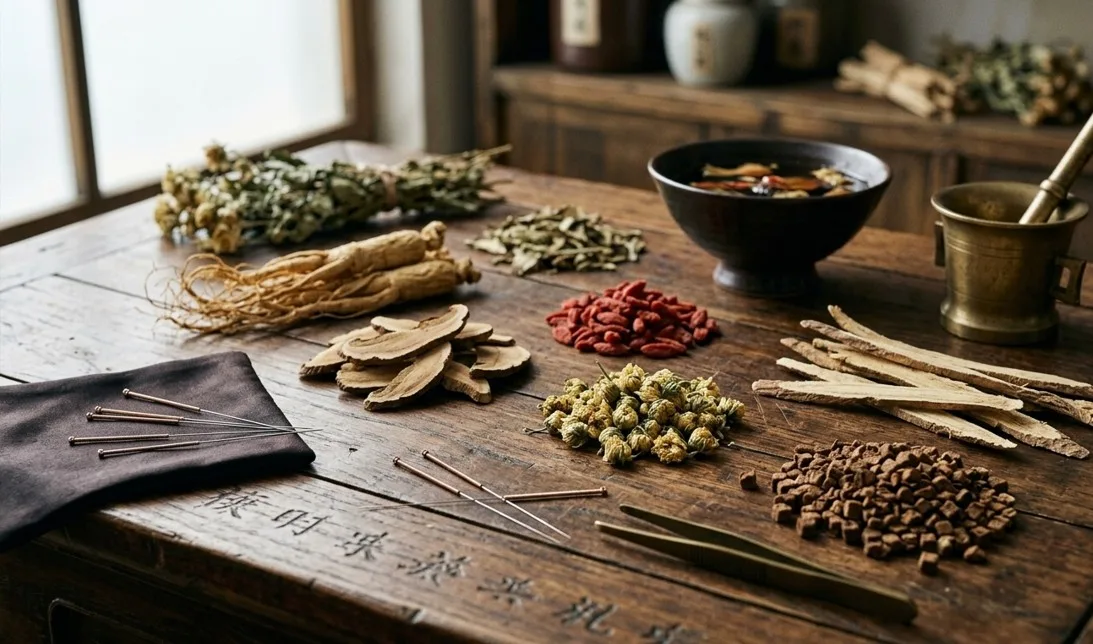
You've probably seen gua sha tools on Instagram, heard a friend rave about acupuncture, or noticed turmeric-and-ginger supplements lining pharmacy shelves. But Traditional Chinese Medicine is far more than trending wellness products. It's a complete medical system with over 2,000 years of clinical practice — and in 2026, it's experiencing its biggest global recognition yet.
Key Takeaways
- The global TCM market reached an estimated $92.67 billion in 2026, growing at 7.18% annually (Mordor Intelligence, 2026).
- WHO adopted the Global Traditional Medicine Strategy 2025–2034 in May 2025, endorsing evidence-based integration of TCM into national health systems.
- Acupuncture is now recommended by the UK's NICE guidelines for migraine and tension headache prevention.
- TCM focuses on prevention and balance rather than treating isolated symptoms — a philosophy increasingly validated by modern integrative medicine.
[INTERNAL-LINK: understanding yin and yang → detailed article on yin-yang balance and health]
What Exactly Is Traditional Chinese Medicine?
In 2026, the global TCM market is valued at approximately $92.67 billion, up from $86.46 billion in 2025 (Mordor Intelligence, 2026). Traditional Chinese Medicine is a comprehensive health system that originated in China more than two millennia ago. It encompasses herbal medicine, acupuncture, cupping, moxibustion, tai chi, qigong, and dietary therapy.
Unlike Western medicine, which typically targets a specific disease or organ, TCM treats the whole person. A practitioner doesn't just ask "where does it hurt?" — they examine your tongue, feel your pulse at multiple points, and ask about your sleep, emotions, and digestion. The goal isn't to eliminate a single symptom. It's to restore the body's internal balance so it can maintain health on its own.
TCM operates on several foundational concepts: Qi (vital energy), Yin and Yang (opposing forces that must stay balanced), the Five Elements (Wu Xing), and the meridian system (energy pathways through the body). These aren't abstract philosophy — they're the diagnostic framework practitioners use to identify where imbalance exists and how to correct it.
Our perspective: Having worked with TCM-based wellness products across three continents, we've observed that people who understand TCM's foundational principles — not just individual remedies — tend to make better long-term wellness decisions.
Why Is TCM Growing So Fast Globally?
Global demand for traditional medicine is projected to rise from $213.81 billion in 2025 to $359.37 billion by 2032, a compound annual growth rate of 7.7% (WHO/PMC, 2025). Three forces are driving this acceleration: institutional recognition, consumer demand for preventive care, and technology.
Institutional recognition
The single biggest endorsement came on 26 May 2025, when the 78th World Health Assembly adopted the WHO Global Traditional Medicine Strategy 2025–2034. This ten-year roadmap calls on member states to strengthen the evidence base for traditional medicine, ensure safety and regulation, and integrate it into national health systems. WHO also established the Global Traditional Medicine Centre in India in 2022 as a global hub for knowledge and innovation.
China's government has listed approximately 3,900 TCM drugs in its national insurance catalog, broadening patient access and accelerating producer revenues. Countries from Malaysia and Nepal to Saudi Arabia and Seychelles co-hosted high-level side events at the World Health Assembly to discuss TCM integration.
Consumer demand
People aren't waiting for institutions to catch up. A 2024 study in the Patient Preference and Adherence Journal analyzed data from 28,993 participants and found that 34% used TCM for chronic conditions, 26.9% for rehabilitation, and 26.3% for sleep disorders. The pattern is clear: consumers are seeking holistic, preventive approaches rather than solely relying on reactive pharmaceutical treatments.
Technology
AI-powered tongue scanners, pulse-reading sensors, and wearable devices that track Qi-related biometrics are bringing TCM into the digital age. In Nanjing, China, a shop called Que Tang Yu Fang uses AI diagnostics to assess customers' yin, yang, and qi levels before blending personalized herbal teas. At CES 2025 in Las Vegas, Link2Care showcased smartwatches combining biometrics with TCM principles. North America is now the fastest-growing market for TCM consumer products.
[INTERNAL-LINK: nanotechnology in wellness → article on how nano-sized particles improve bioavailability of herbal ingredients]
What Are the Core Principles of TCM?
The TCM market's herbal medicine segment captures roughly 50% of global TCM revenue, followed by acupuncture at 20% and cupping at 15% (Business Research Insights, 2026). These therapies all rest on five interconnected principles that guide every diagnosis and treatment.
Qi — vital energy
Qi (pronounced "chee") is the vital energy that flows through every living being. In TCM theory, health depends on the smooth, balanced flow of Qi through the body. When Qi is blocked, deficient, or stagnant, symptoms appear. Acupuncture needles, herbal formulas, and movement practices like tai chi all aim to restore Qi flow.
Yin and Yang — dynamic balance
Everything in TCM is understood through the lens of Yin (cool, passive, internal) and Yang (warm, active, external). These aren't fixed states — they're in constant motion, like day shifting into night. A Yang-excess condition might present as inflammation, fever, or restlessness. A Yin-deficiency might show as dryness, fatigue, or anxiety. Treatment aims to restore balance, not to eliminate one side.
The Five Elements (Wu Xing)
Wood, Fire, Earth, Metal, and Water — each element corresponds to specific organs, emotions, seasons, and tastes. For example, Wood relates to the liver and the emotion of anger; Water relates to the kidneys and fear. This framework helps practitioners spot patterns: if you always get headaches in spring and feel irritable, a TCM practitioner might focus on the liver (Wood element, spring season).
The Meridian System
Meridians are pathways through which Qi travels. There are 12 primary meridians, each connected to a major organ system. Acupuncture points sit along these meridians — there are over 360 classical acupoints. When a practitioner inserts a needle at a specific point, they're targeting a precise location on a meridian to influence energy flow to the associated organ.
The Holistic Approach
TCM doesn't treat a headache as just a head problem. It asks: is the headache on the sides (gallbladder meridian), the forehead (stomach meridian), or the top (liver meridian)? Is it worse in the morning or evening? Does it come with nausea or irritability? Every symptom is a clue to the underlying pattern of imbalance.
Does Acupuncture Actually Work? What the Science Says
A comprehensive review published in January 2026 by the European Society of Medicine found strong evidence supporting acupuncture for chronic musculoskeletal pain, including low back pain, shoulder pain, neck pain, and knee osteoarthritis (ESMed, 2026). This isn't fringe research — it's built on over 7,190 clinical studies, including 1,263 randomized controlled trials.
The UK's National Institute for Health and Care Excellence (NICE) recommends acupuncture for migraine prophylaxis and tension-type headache — a significant endorsement from one of the world's most rigorous medical guideline bodies. For fibromyalgia pain, multiple evidence maps rate acupuncture's effectiveness with moderate to high certainty.
How does it work? Modern neuroscience suggests that acupuncture stimulates the release of endorphins, modulates the nervous system, and reduces inflammatory markers. The International Association for the Study of Pain (IASP) confirms that acupuncture has been shown to be beneficial for pain control and reducing inflammation. It's not magic — it's measurable physiology activated through precise anatomical targeting.
Worth noting: The gap between scientific evidence and public perception is narrowing fast. As of 2026, acupuncture is supported by a larger evidence base than many commonly prescribed pharmaceutical interventions for chronic pain.
[INTERNAL-LINK: TCM vs Western medicine → comparison article on integrative approaches]
How Does TCM Approach Prevention?
The TCM philosophy of "treating disease before it arises" (治未病, zhì wèi bìng) predates modern preventive medicine by centuries. Rather than waiting for symptoms, TCM practitioners assess constitutional patterns — your unique combination of Qi strength, Yin-Yang balance, and organ tendencies — and recommend diet, lifestyle, and seasonal adjustments to maintain health.
This aligns remarkably well with contemporary wellness trends. The global shift toward preventive healthcare, with consumers focused on maintaining energy, sleep quality, and immune function rather than waiting for illness, mirrors exactly what TCM has practiced for millennia. Seasonal eating, stress management through movement (tai chi, qigong), herbal tonics for immune support, and sleep-supporting practices are all standard TCM prescriptions.
The Healthy China 2030 national policy explicitly promotes TCM integration into mainstream preventive healthcare, signaling that even at the government level, the preventive model is gaining official backing.
[INTERNAL-LINK: daily wellness habits → article on morning routines inspired by TCM principles]
Is TCM Safe? Understanding Quality and Regulation
Safety is the question everyone should ask — and the honest answer is that quality varies enormously. Raw herbs sourced without quality control may contain heavy metal residues, pesticide contamination, or incorrect species. This is why WHO's 2025–2034 strategy places safety, regulation, and quality assurance among its top four objectives.
Reputable TCM products undergo standardized extraction, laboratory testing for contaminants, and dosage verification. Countries like Canada, Switzerland, Australia, and New Zealand have formal licensing and regulation frameworks for TCM practitioners. In the EU, herbal medicines must meet the Traditional Herbal Registration scheme requirements.
What to look for when choosing TCM products: third-party lab testing certificates, Good Manufacturing Practice (GMP) certification, clear ingredient lists with Latin botanical names, and transparent dosage information. Products that make vague claims without specifiable ingredients should raise red flags.
From our work: The TCM products we partner with use nanotechnology-enhanced extraction to improve bioavailability while maintaining strict quality testing protocols. The difference between a well-manufactured TCM product and a generic herbal supplement is significant — and it starts with sourcing and production standards.
What's the Future of TCM?
In 2026, TCM sits at an intersection of ancient wisdom and modern technology that would have been unimaginable a decade ago. AI-powered diagnostics are making TCM more accessible. Nanotechnology is solving the bioavailability problem that has limited herbal medicine's effectiveness. Wearable devices are translating TCM concepts into data that Western-trained physicians can engage with. And institutional recognition — from WHO to national health systems — is providing the regulatory framework that builds consumer trust.
The second WHO Global Summit on Traditional Medicine is set to advance implementation of the 2025–2034 strategy, with a focus on evidence, innovation, biodiversity, intellectual property, and the transformative potential of frontier technologies.
TCM isn't replacing modern medicine. It's complementing it — offering a system of preventive care, chronic condition support, and holistic health maintenance that fills gaps pharmaceutical medicine was never designed to address.
[INTERNAL-LINK: nanotechnology in wellness products → pillar page on nano-enhanced bioavailability]
Frequently Asked Questions
Is Traditional Chinese Medicine scientifically proven?
Multiple areas of TCM have robust clinical evidence. Acupuncture for chronic pain is supported by over 7,190 clinical studies, including 1,263 RCTs, and the UK's NICE guidelines recommend it for migraine prevention (ESMed, 2026). Research continues to expand across herbal medicine, cupping, and tai chi.
Can I use TCM alongside Western medicine?
Yes — this is called integrative medicine, and it's growing worldwide. Many hospitals in the US, Germany, and Australia now offer TCM therapies alongside conventional treatments, particularly for cancer recovery support, fertility, and chronic pain management.
How do I find a qualified TCM practitioner?
Look for practitioners with formal TCM education (typically 4–5 years), national or state licensing, and membership in professional associations. In countries with formal TCM regulation — Canada, Australia, Switzerland, New Zealand, the UK — licensing bodies maintain public registers.
Are TCM herbal products safe to take?
Quality matters enormously. Choose products with GMP certification, third-party lab testing, clear ingredient lists, and transparent manufacturing information. Avoid products making disease-cure claims or lacking ingredient specifics. Consult a healthcare professional before combining herbal supplements with prescribed medications.
What's the difference between TCM and other traditional medicines?
TCM is one of several codified traditional medical systems worldwide, alongside Ayurveda (India), Unani (Middle Eastern/South Asian), and various indigenous healing systems. Each has distinct diagnostic frameworks, herbal pharmacopeias, and treatment modalities. WHO's 2025–2034 strategy covers traditional, complementary, and integrative medicine broadly, recognizing the value of multiple traditions.
Max White is a wellness business consultant and WHIEDA partner specializing in TCM-based health products across European and African markets. He writes about the intersection of traditional medicine, modern science, and wellness entrepreneurship.
Sources:
- Mordor Intelligence, "Traditional Chinese Medicine Market," retrieved 2026-05-11, https://www.mordorintelligence.com/industry-reports/traditional-chinese-medicine-market
- WHO, "WHA78: Traditional medicine takes centre stage," retrieved 2026-05-11, https://www.who.int/news/item/02-06-2025-wha78--traditional-medicine-takes-centre-stage
- PMC, "Policy implications of WHO's Global traditional medicine strategy 2025–2034," retrieved 2026-05-11, https://pmc.ncbi.nlm.nih.gov/articles/PMC12578523/
- ESMed, "Efficacy of Acupuncture for Pain Management: A Review," January 2026, retrieved 2026-05-11, https://esmed.org/efficacy-of-acupuncture-for-pain-management-a-review/
- Business Research Insights, "Traditional Chinese Medicine Market," 2026, retrieved 2026-05-11, https://www.businessresearchinsights.com/market-reports/traditional-chinese-medicine-market-109110
- Patient Preference and Adherence Journal, TCM usage study, January 2024
- IASP, "Acupuncture for Pain Relief," 2025, retrieved 2026-05-11, https://www.iasp-pain.org/resources/fact-sheets/acupuncture-for-pain-relief/