Here's something most supplement labels won't tell you: it doesn't matter what's in the capsule if your body can't absorb it.
Take curcumin — the golden compound in turmeric behind most of the spice's health benefits. Thousands of studies confirm its anti-inflammatory and antioxidant properties. But regular curcumin has roughly 1% oral bioavailability in its raw form (Yang et al., PMC). A 500mg capsule? Your body might actually use about 5mg.
Key Takeaways
- Regular curcumin has approximately 1% bioavailability — 99% passes through unused.
- Piperine (black pepper) enhances curcumin absorption by up to 2,000%.
- Nano-formulations further improve solubility, stability, and sustained release.
- Delivery technology matters more than the amount on the label.
This isn't a curcumin problem. It's a particle size problem.
What Does Bioavailability Actually Mean?
Bioavailability is the percentage of an active ingredient that reaches your bloodstream in a usable form. A substance can work perfectly in a lab dish — but if it can't survive stomach acid, dissolve in water, or cross the intestinal wall, it's therapeutically useless inside your body.
Many natural compounds face this barrier. They're lipophilic (fat-soluble) but poorly water-soluble. Since absorption happens through the watery environment of your gut, they need help getting across.
How Does Nanotechnology Solve This?
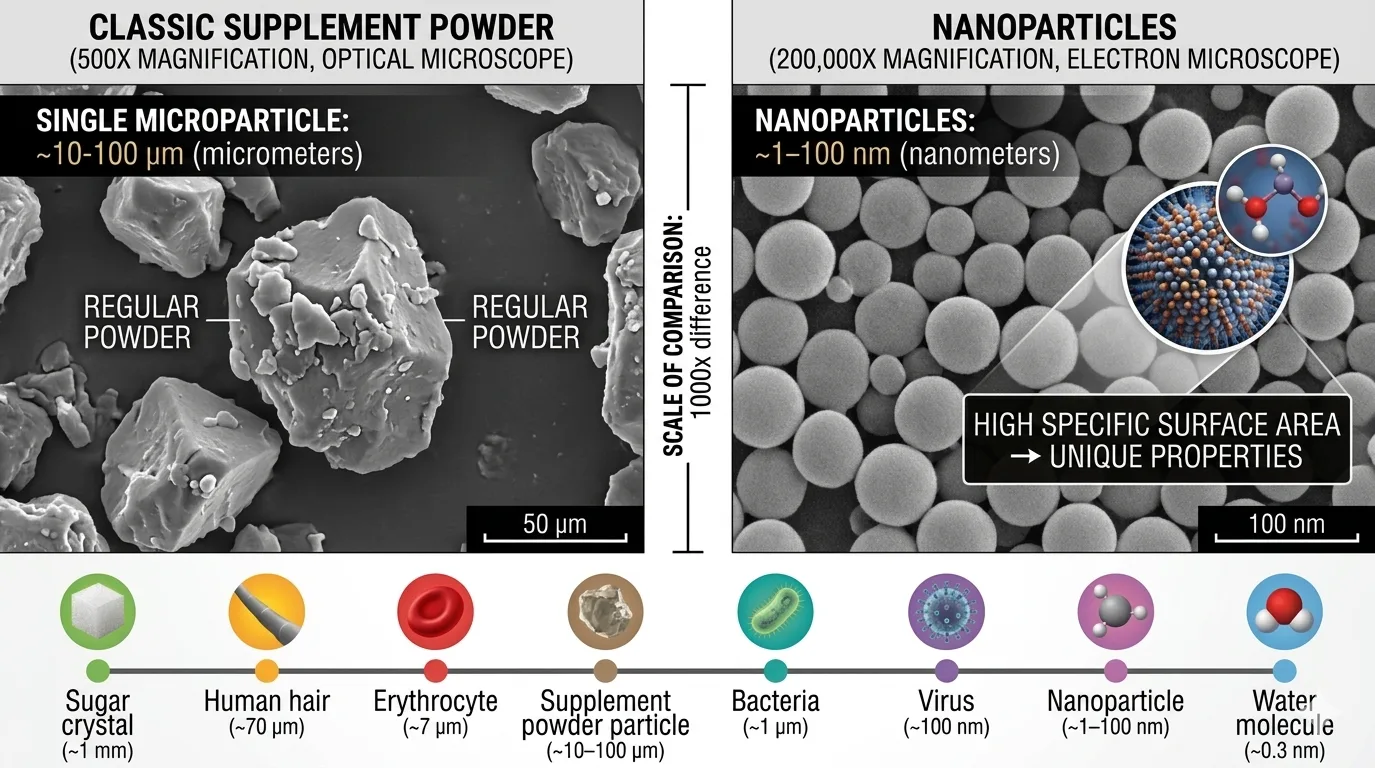
The principle is simple: make the particles smaller, increase the surface area, improve absorption.
When curcumin is encapsulated into nanoparticles — liposomes, micelles, or polymeric nanostructures — its water solubility and oral bioavailability increase dramatically. Nano-formulations extend the compound's half-life, improve stability, and enable sustained release so the active ingredient stays in your system longer.
This isn't theoretical. Research published in Antioxidants (2024) confirmed that nanotechnology-applied curcumin shows notably improved water solubility and gut absorption compared to standard formulations (PMC).
Our perspective: The wellness products we work with use nano-extraction technology specifically to close this absorption gap. The difference between a nano-formulated ingredient and a standard one isn't marketing — it's measurable bioavailability.
What Should You Look For?
Next time you're choosing a supplement, don't just read the ingredient list. Ask: what's the delivery technology? A 100mg nano-formulated ingredient can outperform a 1,000mg standard one — because it actually reaches your cells.
The gap between "contains" and "absorbs" is where most supplements fail. Nanotechnology closes that gap.